

A teaching article for Riggs Ventures church security training
The Question Behind the Question
Every church safety team eventually asks a version of the same question: “How do we keep our people safe?” It is a good question. It is not the first question.
The first question is: “What is this ministry for?”
If a church answers that question with the Great Commission — make disciples, baptize, teach, proclaim Christ crucified and risen — then the safety ministry must be built to serve that mission, not to compete with it. A security program that makes a congregation feel guarded, but unwelcoming has protected the building and undermined the purpose of the building.
The goal is not a fortress. The goal is a place where the gospel can be preached without interruption, where a stranger can walk in and be met, where a child can be dropped off without fear, and where the worst day in a family’s life can be met by people who are ready. Safety is not the mission. Safety is what allows the mission to continue.
Theology of the Watchman
Scripture does not treat vigilance as a lack of faith. It treats vigilance as a form of love.
Nehemiah rebuilt the wall in a hostile environment. His response to credible threat was not panic, and it was not denial. He prayed, and he posted a guard: “we prayed to our God and set a guard against them day and night” (Nehemiah 4:9). Both halves of that verse matter. Prayer without preparation is presumption. Preparation without prayer is self-reliance. Nehemiah’s builders worked with a tool in one hand and a weapon at their side, and the work got finished.
Ezekiel 33 gives the watchman his job description. The watchman’s duty is to see and to speak. If he sees the sword coming and does not blow the trumpet, the blood is on his hands. The watchman is not asked to guarantee outcomes; he is asked to be awake and to warn. That is the standard for a church safety team. You are not guaranteeing that nothing bad will ever happen. You are accepting responsibility to be awake, trained, and willing to speak up.
Proverbs 27:12 — “The prudent see danger and take refuge, but the simple keep going and pay the penalty.” Prudence is a virtue, not a lapse of trust.
1 Timothy 5:8 establishes that failing to provide for your household is a failure of faith. A congregation is a household. Provision includes protection.
Luke 22:36 shows Jesus telling His disciples to be practically prepared for a hostile road ahead — and then, in the garden, correcting Peter’s misuse of force. Both instructions stand together. Readiness is commanded; recklessness is rebuked. That tension is the whole discipline of church security: fully prepared, deeply restrained.
And behind all of it, Psalm 127:1 keeps the team humble: “Unless the LORD watches over the city, the watchmen stand guard in vain.” We train hard. We trust God. Neither cancels the other.
Leadership Before Tactics
Most church safety failures are not tactical failures. They are leadership failures that showed up on a bad day.
Leadership decides whether the team exists, whether it is trained, whether background checks happen, whether the pastor knows the plan, whether volunteers are screened or simply welcomed. Equipment is easy to buy. Culture is the hard part.
Four leadership commitments a church safety ministry cannot function without:
- Pastoral/Elder/Deacon ownership. If safety is a hobby of men in the back row, it will collapse under the first conflict. It must be an authorized ministry with a named leader, a reporting line, and the pastor’s public support from the platform.
- Written policy. Verbal understandings evaporate under stress and in litigation. Medical response, missing child, custody dispute, threatening behavior, weapons policy, use-of-force limits, interna and external theft, media contact— each needs a short, plain-language written protocol that a nervous volunteer can follow at 10:40 on a Sunday morning.
- Honest screening. The most likely serious harm in a church is not an active shooter. It is child abuse, elder financial exploitation, and fraud committed by someone the congregation already trusts. Background checks, two-adult rules, check-in and check-out systems, dual signatures on money, and separation of financial duties prevent far more damage than any door hardware.
- Repetition. A plan that is not drilled is a plan that does not exist. Short, frequent, unglamorous rehearsals beat an annual seminar. Walk the evacuation route. Practice the lockdown announcement. Run the medical scenario with the actual AED.
And the discipline that separates a mature team from an eager one: restraint. The best safety volunteer is the one who de-escalates a hundred situations and never has to do anything anyone notices. Ego is a liability. Uniform envy is a liability. The team member who wants a story to tell is the greatest risk in the room. Recruit humble people, train them thoroughly, and hold them accountable.
The Practical Baseline
A church of any size can put these in place without a large budget:
- Threat and vulnerability assessment. Know your actual risks — geography, congregation profile, cash handling, children’s ministry, parking lot, single points of entry, public visibility of leaders.
- Layered access. Greeters and parking lot presence outward; controlled entry points inward; children’s ministry as the most protected layer.
- Communication. A defined way for a volunteer in the nursery to reach the team leader in under fifteen seconds. Radios, a group text tree, whatever works — but tested.
- Medical readiness. AED, trained users, stop-the-bleed kits, and a plan to meet EMS at the door. Medical events will outnumber violent events by a wide margin.
- Relationship with local responders. Invite police and fire to walk your building before you need them. Give them floor plans, access codes, and a contact list.
- Behavioral awareness over profiling. Train on behavior — pre-attack indicators, escalating agitation, boundary testing, grooming behaviors — never appearance, ethnicity, or economic status. Profiling is both ineffective and a denial of the image of God in the person standing in front of you.
- A reunification and care plan. After any incident, families need information and comfort. That is ministry, and it should be planned in advance.
Crisis as the Church’s Open Door to Ministry
Here is the part that most security training will never tell you.
The world is loud with crisis — violence, disaster, economic fear, political rage, isolation, addiction, family collapse. In crisis, the things people normally use to hold themselves together stop working. Money does not fix it. Status does not fix it. Certainty is gone. And in that moment, people who have never asked a spiritual question in their lives start asking one.
That is the church’s open door.
When the tornado hits, the church with a plan is the church that can feed a neighborhood. When the family loses a child, the congregation with trained, calm, present people is the congregation that can sit in the ashes with them. When a threat comes to the sanctuary and the team responds with competence and without cruelty, the watching community learns something true about the God that church claims to serve.
The early church grew fastest in plague, persecution, and poverty — not because the crisis was good, but because the Christians did not run. They stayed, they served, and they explained why. 1 Peter 3:15 ties readiness and witness together in one sentence: “Always be prepared to give an answer to everyone who asks you to give the reason for the hope that you have — but do this with gentleness and respect.” Standing Firm–Prepared. Gentle. Ready to explain the hope.
So, the safety team is not the opposite of the evangelism team. On the hardest day your church will ever have, the safety team is the front of the evangelism team. You are the first face a frightened visitor sees and the last one they remember. Your competence buys the church credibility; your compassion can lead them to Christ.
2 Corinthians 1:3-4 names the pattern: God comforts us in our troubles so that we can comfort others with the comfort we received. A church that has thought seriously about crisis becomes a church that can carry other people through theirs. That is not risk management. That is discipleship.Security teams are not guarding a building. They are guarding a gathering of people whose message is that there is hope on the far side of the worst thing that can happen.
So, train like that is true.
Riggs Ventures provides training and exercises so church leaders and volunteers can gain experience when lives are not in dangers.
Two instructors are available for this training: Both with Law Enforcement Credentials and, more important, Christians who have faithfully served in churches.
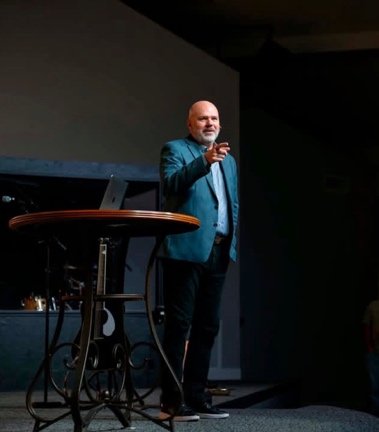
Troy Riggs
Troy Riggs is a 30-year public safety leader who has been called upon to oversee public safety agencies in three of America’s largest cities—Denver, Indianapolis, and Louisville. He is also a Southern Baptist ordained minister and deacon.

Dr. Phil Russell
Dr. Phil Russell enjoyed a 30-year career as a police officer, while also working in various fields of ministry in one of America’s largest churches. He is currently a member of a Southern Baptist Church in Louisville, KY.

Riggs Ventures — safety, security, and crisis leadership for churches